Sunday, September 7, 2014

Making a Jacob's Ladder Better

Around a year ago, my friend, Max Justicz, was graduating high school and headed off to MIT. As a parting gift, he gave me his 12000 volt neon sign transformer. It's been sitting in my closet since then, so I decided to finally put it to good use and make a Jacob's Ladder.


This was definitely cool, but it needed some improvement. Also a little over a year ago, my former robotics coach left our school to live in Connecticut with his wife. He let me keep his 12V air compressor, and for the longest time, I've been searching for a project to use it in. I realized that I could probably use the compressor to make the Jacob's Ladder spark upwards even faster by using the compressor to pump air along the wires in the direction of the arc's movement. This was the result:


As you can see, this was totally awesome. It ended up making something that looks almost like a plasma sword. This project was definitely worth the small amount of effort it took to create it. Overall, it's one of the coolest things I've built.

Thursday, September 4, 2014

Kerbal Space Program: Building a Low Orbit Fueling Station

For awhile, I wanted a way to practically apply my docking skills (that is, having one spacecraft attach to another in space). I used a little bit of the Infernal Robotics mod, but not much. I started off by sending up two base modules and docking them.

Two of these were attached at the front (the end with less docking ports)
After attaching the base modules, I sent up two large fuel tanks attached to one ship. I docked the first tank, then separated the second one, and then docked the second one.

Docking the first of the two orange tanks while the second is still attached. 

The completed station, with both fuel tanks docked. 
The station was complete. It had nearly full fuel tanks, solar panels for electricity, and six docking ports for refueling ships and future additions.

Kerbal Space Program: To Eve (Venus)!

For my next interplanetary mission, I decided to send my Laythe craft to Eve, the KSP equivalent of Venus. This mission was a bit different than my previous missions because, unlike the previous two, my target planet is closer to the sun that Kerbin. this means I had to do my Hohmann transfer in reverse.

As I descended toward the planet, however, I realized that I forgot to account for the composition of the air: Eve's thick, purple atmosphere contains no oxygen. This means that the air breathing jet engine that worked on Laythe would not work here. As a result, I had to rely on luck and try to glide myself to the nearest land.


However, I managed to make it to an island just before I hit the ground.


I deployed my parachutes, and I was able to add Eve to my list of visited celestial bodies!


Kerbal Space Program: To Laythe!

     After the success of my mission to Duna (Mars), I decided to build another rocket. This time, however, I would head for the Joolian System. In Kerbal Space Program, Jool is the equivalent to Jupiter. Laythe is the closest of Jool's five moons, but it is unique in that it has liquid oceans and an oxygen rich atmosphere. This means that air-breathing jet engines will work in its atmosphere. Knowing this, I decided to redesign my rover to be more of a small airplane:


This design had an air intake on its front end and a jet engine on its back, so I couldn't simply stick it on top of a rocket. Instead, I had to sandwich it between two rockets. You can see the rover at the top of this rocket between the two thin, tall fuel tanks:


Notice also the fuel tanks mounted radially around the bottom. Fuel flows from the top tanks and down the chain until it flows into the engine. When a tank runs out, it is ejected with small "separtron" solid boosters. I call this "skeleton staging" due to the fuel tanks' resemblance to a rib cage. I came up with this idea because I wanted a way to eject fuel tanks without ejecting the engines attached to them. It began as a bit of an exercise in absurdity, but it ended up working quite nicely.

I once again used nuclear engines to get a transfer after I had achieved Kerbin orbit. After a lot of time warp, I finally encountered Laythe. Here, you can see Jool (right), Laythe (left), and my craft (middle). You may need to adjust your brightness to see my ship, as I was taking a picture of it from the dark side.


Here's a shot of Laythe in the sun:


Upon entering the atmosphere, I managed to glide the craft for awhile before I throttled up the jet engine. After starting the burn, I did a steady cruise to the nearest island.


Also worth mentioning: Laythe is tidally locked to Jool. This means that the same side of Laythe always faces Jool, just like the same side of the Moon always faces Earth. I managed to get this shot of Jool in the sky as I was flying:


After cruising to an island, I landed the rover with a parachute. Unfortunately, I popped both my back tires upon landing. I could still move around though, and I could even take off again without too much trouble.


That was the end of my mission to Laythe. Next, I sent the same craft to Eve, the KSP equivalent of Venus.

Kerbal Space Program: To Duna (Mars)!

     When going back through some of my old projects, it occurred to me that I should share my Kerbal Space Program missions. KSP is a video game / flight simulator where the player creates rockets and flies them to various locations around the solar system. My first interplanetary mission was a rocket to Duna, the KSP equivalent of Mars. I managed to build a powerful rocket to get a rover into low orbit, and then I used the highly efficient Nuclear Engine to intercept the planet.

Here you can see my orbit (orange) as I leave Kerbin to intercept Duna. This is a form of Hohmann transfer. I chose this over a bi-elliptic transfer because it's faster and easier.


After a few months of in-game time, I'm able to see Duna and its moon, Ike, in the distance.


As I got closer, I started to get a sense of the scale of things:


I managed to catch this beautiful view just before my descent into the atmosphere:


I used a parachute to slow the descent of the rover. However, since the atmosphere is considerably thinner on Duna, the parachute alone wasn't enough to land the craft. To slow the rover in its final stages of descent, I used a skycrane similar to the one used by the curiosity rover. Here is the landed craft with the skycrane still attached:


Here is the rover with the skycrane jettisoned:


That was the end of my Duna/Mars mission. The rover functioned well and I managed to explore quite a bit of the Martian landscape. This mission set the stage for me for future interplanetary missions, like my mission to Laythe.

Tuesday, August 12, 2014

Creating a 2D Fractal Landscape Generator in Python

     I've been fascinated with fractals for a good while now, so a few months ago, I decided to create a python program to generate fractal mountains. The program works by starting a triangle with random vertices. Then, it divides the triangle into 4 smaller triangles and randomizes the locations of the new vertices.

In the program, I had to create classes for both the nodes (vertices) and the connections between the nodes. I had to give the nodes attributes for both their Cartesian coordinates (location in the image) and their barycentric coordinates (location in the overall triangle). Then, I had to create a roughness parameter (to define how much the nodes would be randomized) and an iterations parameter to define how many times the program would repeat. Then, I made a "for" loop to run through each triangle of connections, create new nodes for the midpoints, connect them up with new edges, and randomize them. Here's some of the results:

Iterations = 6, roughness parameter = 0.2

Iterations = 5, roughness parameter = 0.2
Iterations = 6, roughness parameter = 0.25

Iterations = 5, roughness parameter = 0

You can have a look at the code here.

Cosplay for DragonCon: Corvo Attano

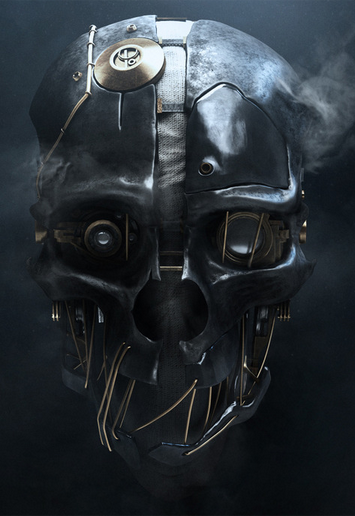
     For DragonCon 2013, I decided that I wanted to cosplay Corvo Attano from the game Dishonored


     I started on the mask by hammering cinefoil onto a prop skull, then cutting the result in half.


Then, I held the two halves together by gluing them to a bunch of speampunk-looking objects. I used washers for the right eyepiece and an doorknob cover for the left one. The jawpieces were held on with glue and copper wire, and I added some extra brass pieces just for decoration.

My Mask

My Mask
Corvo's Mask
     The result certainly wasn't perfect, but I felt it stayed pretty loyal to the real thing. For the Jacket, I bought a black trenchcoat from the thrift store and used acrylic gold paint to add the trim. I added an assortment of belts and other accessories to add to the authenticity, and purchased some boots from the thrift store to complete the getup.


However, a Corvo cosplay wouldn't be complete without his retractable sword. It just so happens that Amazon sells extendable swords for Tai Chi training. This sword is awesome, and for around 13 bucks, it's  a great toy to have. After wielding my new sword, I was all set to head off to DragonCon.